

Spinoza Prize for chemical biologist Hermen Overkleeft
Professor of Bio-organic Chemistry Hermen Overkleeft (KNCV Gold Medal Winner 2008) develops innovative methods to study disease processes. This increases our understanding of the human body and enables the development of new medicines. Overkleeft has been awarded the Spinoza Prize: the most prestigious scientific award in the Netherlands.
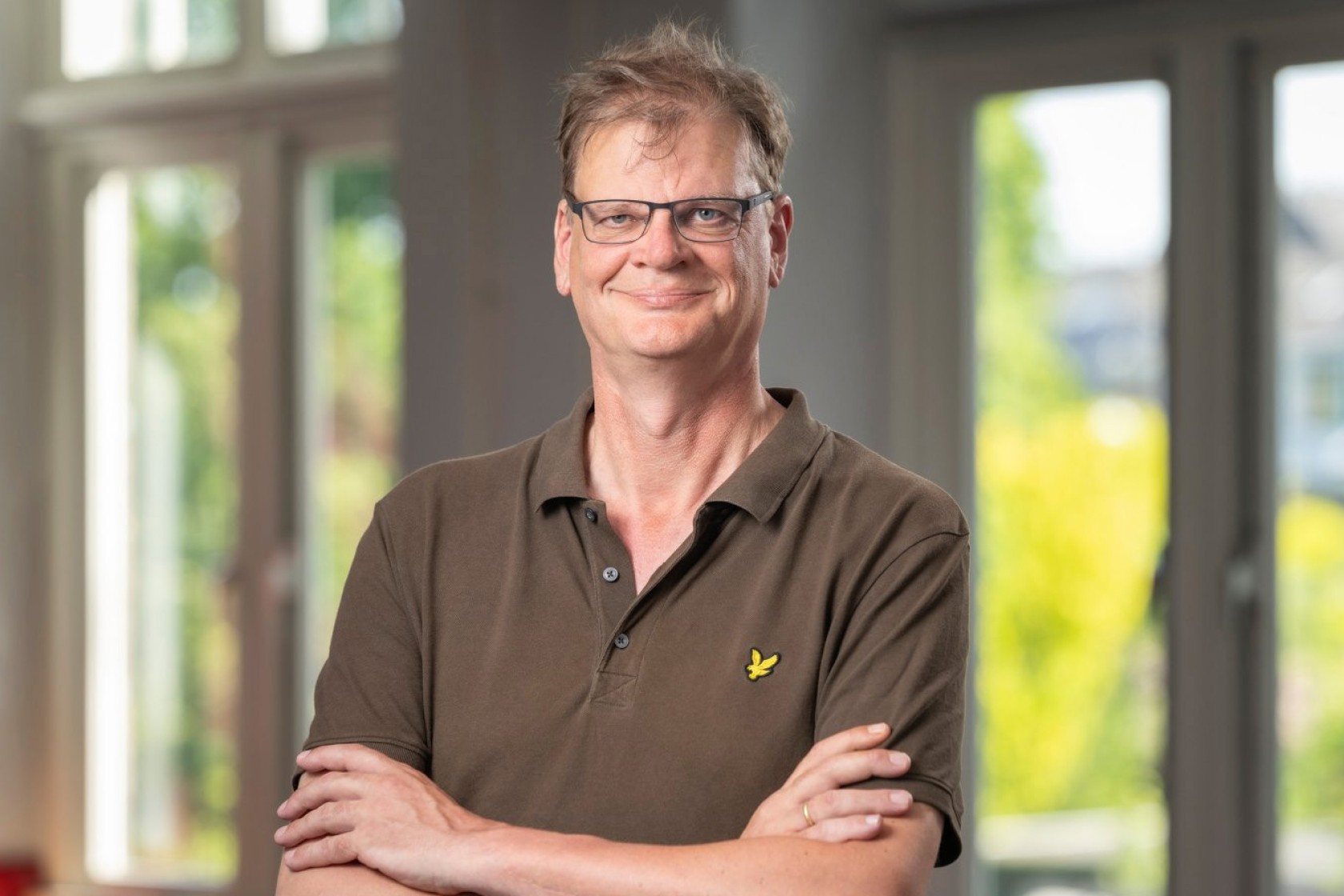
Image: Studio Oostrum
Overkleeft is regarded worldwide as one of the pioneers of chemical biology, a field that designs molecules to study, understand and influence biological processes. He explains it as follows: a cell can be seen as a factory with an assembly line, where different machines work together to produce, for example, proteins, fats and copies of DNA.
However, things sometimes go wrong in such a factory. If one of the machines malfunctions, this affects the rest of the assembly line, leading to incomplete products or even toxic substances. In the human body, this can lead to disease.
‘We can examine in great detail what each cog in that factory does’, Overkleeft explains. ‘We do so by creating molecules in the lab that resemble those found in a cell, such as sugars. By attaching a light to them, we can track them and see how they interact with one of the machines on the assembly line – an enzyme.
‘This is how we try to understand and influence processes in the body. It’s fundamental research that can lead to medicines for metabolic disorders, certain types of cancer and the flu virus, for example.’
Drug development
Decades of research have already led to three biotech companies co-founded by Overkleeft. These focus, among other things, on potential cancer therapies and a drug for several metabolic disorders. In these conditions, the body is unable to break down certain sugar derivatives. As a result, substances accumulate, causing damage to the brain and nervous system.
In metabolic disorders, part of the assembly line works well, but one of the machines fails to keep up with the pace. This leads to an accumulation of incomplete products, effectively creating a waste heap that is too large for the recycling process to handle.
One possible solution would be to replace the malfunctioning machine (an enzyme) with a functioning one. However, these proteins are often too large to enter the brain, so they do not provide an effective solution for every disease. Overkleeft and his team have therefore developed an alternative approach.
‘We make sure the rest of the factory adapts to the slower machine by adding a molecule that slows down the process. Fewer products are then made, but that’s something the body can cope with. We can also block steps in the process that lead to the formation of toxic substances.’
This approach is currently being tested by Azafaros in an advanced stage of clinical trials involving patients.
Molecule library
Overkleeft and his colleagues also make the molecules they produce available to other scientists through a kind of molecule library. ‘I thought I could just make the data available, but then other researchers would still have to produce the molecules themselves, which takes a great deal of time. Doing it this way accelerates research worldwide, and it often leads to great collaborations.’
Prize means freedom
The recipient of the Spinoza Prize, awarded by the Dutch Research Council (NWO), is awarded €1.5 million to spend at their own discretion on scientific research and related activities. This gives Overkleeft considerable freedom. He already has ideas on how he will use the funding.
‘I’m over the moon. It’s a fantastic prize to receive. I’ll be able to appoint some PhD candidates, and I also want to explore whether we can develop molecules that help break down plants and trees in a sustainable way. Biotechnology is desperate for this because you’d then be able to produce biofuel more sustainably. But before I do anything, I want to discuss what to do with my colleagues at the Leiden Institute of Chemistry. I very much see the Spinoza Prize as a team achievement.’
Share this post!