

Detection of the use of chemical weapons
Evening lecture by Dr. J.M. de Bruin, organized by the Groningse Chemische Kring.
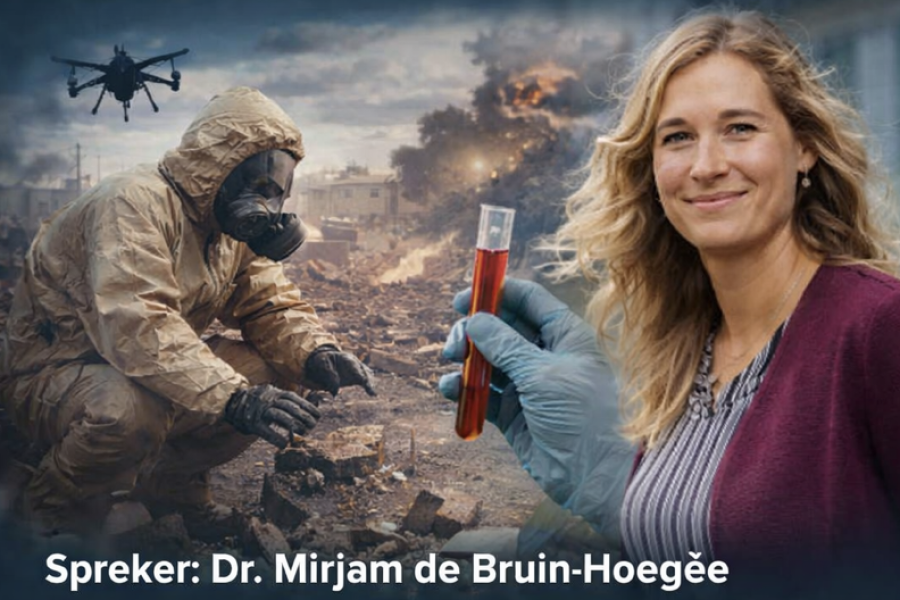
Evening lecture by Dr. J.M. de Bruin, organized by the Groningse Chemische Kring.
Detection of the use of chemical weapons
Summary
Since ancient times, toxic substances have been used as chemical weapons. More recently, these substances have been used by Russia in the armed conflict in Ukraine and to eliminate political opponents. When the use of chemical weapons is suspected, it is often difficult to prove. The toxic substances are reactive and break down quickly in the environment. It is also sometimes unsafe to search for traces immediately after an attack, which means that much evidence can be lost.
This lecture presents new forms of evidence that are important for the chemical identification and disclosure of the origin of chemical weapons. Firstly, victims can be an important source of evidence, as biomarkers of chemical warfare agents can be found in the body for months. Even traces of impurities from the production of chemical weapons can be present in the blood. This can provide an important forensic “fingerprint” that can be used to accurately reconstruct events and identify the perpetrators. Secondly, when it is not possible to access biomedical samples, even plants can provide evidence of a chemical attack. Finally, the components of the dispersal agent itself can reveal information about the perpetrator. It is possible to determine where the components were purchased from a small piece of plastic, for example from a drone or improvised explosive device. Ultimately, the aim is for these new methods to contribute to the collection of evidence for (war) crimes, so that criminals are convicted and potential new perpetrators are deterred.
Background of Dr. J.M. de Bruin-Hoegée Mirjam de Bruin-Hoegée obtained her bachelor's degree in Chemistry from Utrecht University. She then completed a master's degree in Forensic Science at the University of Amsterdam, during which she took various courses at Delft University of Technology. Research in the field of CBRN (chemical, biological, radiological and nuclear) appealed to her greatly and after her studies she went to work at TNO in the CBRN Protection department in the Defence and Security unit. After working there for three years, she started a PhD with the Analytical Chemistry group at the University of Amsterdam in collaboration with TNO. The PhD, supervised by Prof. Arian van Asten and Prof. Peter Schoenmakers, focused on revealing the origin of chemical weapons. Last year, she successfully defended her thesis and obtained her doctorate with honours. She is currently working as a scientist at TNO in Rijswijk and was named TNO Young Excellent Researcher of 2025. Important topics include profiling in biomedical samples, chemical attribution, characterising dispersal agents, and applications of AI and data science in the field of CBRN.
Invitees are very welcome.
Please let us know in advance if you plan to attend.
Send an email to gck@kncv.nl or kommer.brunt@planet.nl.